Adding music to a store can look like a bigger project than an owner wants to start. New wiring, ceiling work, equipment nobody on staff has a reason to know how to spec. "What if we don't have speakers?" is the question we hear more than any other, and it's a reasonable place to hesitate.
You don't have to work out what's needed on your own. We'll review the store's layout and recommend what it would take, at no charge. A fair number of stores also turn out to have usable equipment already sitting in the building.
What does a store actually need?
Three things. Something to play the music, something to amplify it, and speakers to carry it across the floor.
Speakers and amplifiers are standard commercial equipment, and members can source them wherever they like. Nothing about them is proprietary.
Larger stores sometimes add zones, so the garden center can run at a different volume than the service counter, or so announcements reach the sales floor without carrying into an office. That's a refinement, not a requirement to start.
Can you use equipment the store already has?
Possibly, and it's worth checking before pricing anything new.
A lot of hardware stores have an overhead paging system, an intercom, or an amplifier that a previous owner installed and nobody has touched since. If there are speakers in the ceiling and an amplifier somewhere in the back, the store may already have much of what it needs.
Partial equipment counts too. Working speakers with a dead amplifier, or a good amplifier feeding speakers that were never extended into an addition, are smaller problems than starting from nothing.
The practical step is to send photos and model numbers of whatever's there. That helps us identify what you have and what might be reusable. Whether it all still works has to be confirmed on site, but knowing what's installed narrows things down quickly.
How do you know how many speakers you need, and where they go?
That part we handle. Approximate dimensions, ceiling height, and a simple sketch of the layout are enough to work from, and it doesn't need to be drawn to scale or produced by an architect. We'll come back with how many speakers, what type, and where they should go. There's no charge for it and it doesn't commit you to anything.
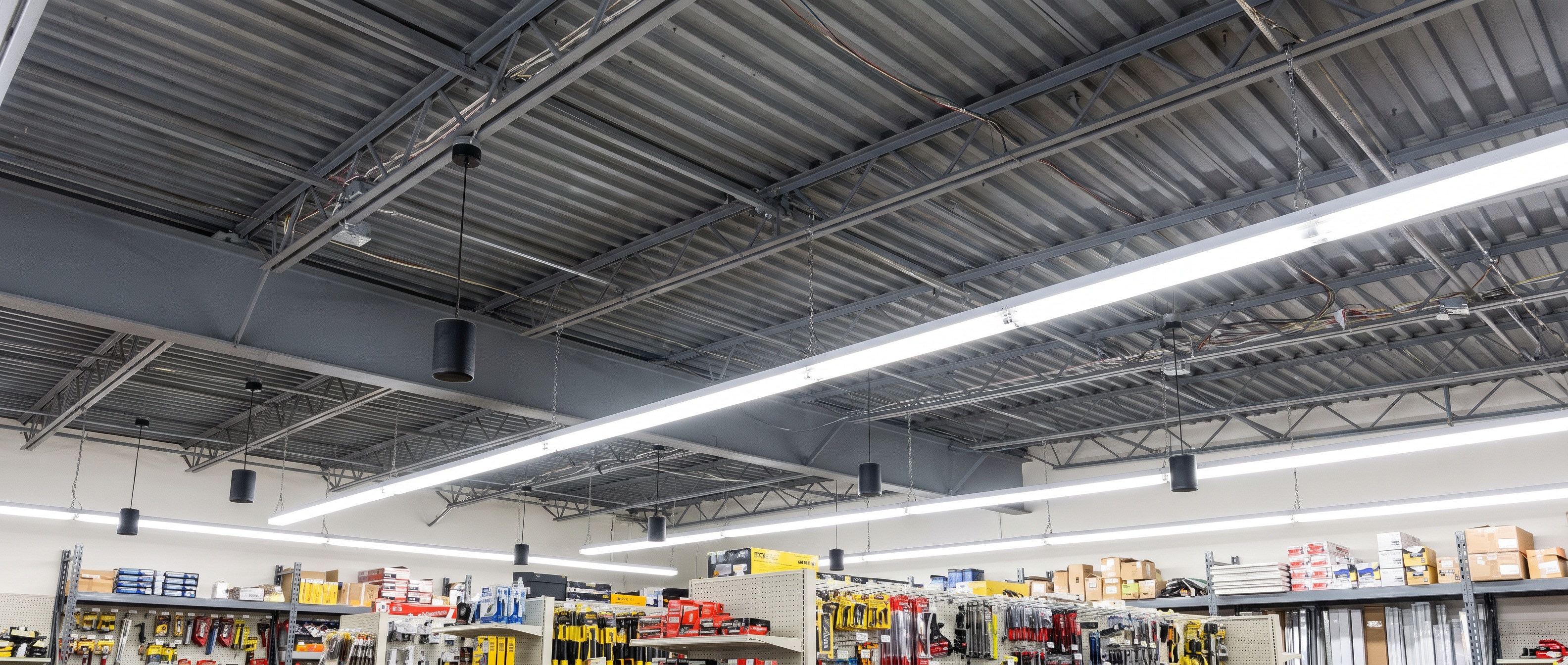
The building is what drives the answer. High ceilings change how sound carries, gondolas block and absorb it unevenly, and a lot of stores are a series of additions rather than one open room. All of it has to be accounted for before anything gets mounted.
Outdoor areas are planned separately. Speakers mounted inside shouldn't be relied on to cover a garden center, a lumber yard, or a seasonal tent, and equipment in those spaces has to stand up to weather.
Do you need an installer?
It depends on the work and on who's available to do it. Connecting a new source to a system that already exists is often straightforward. New wiring, mounting in high or awkward spots, and anything running outdoors usually call for someone who does this for a living.
Some members may have the experience and the equipment to handle the installation themselves. If you'd rather not, we'll call around locally and put some options in front of you.
What does Do it Best Radio provide?
The music, and a player if you want one. The stream can run from a computer the store already has, so the player isn't required, though most stores end up choosing one because it's less hassle.
A computer wired into the store speakers puts sounds from that computer onto the sales floor, which could mean the Windows startup chime at open, or whatever someone in the back room has playing on YouTube. A dedicated player only ever plays the stream, and nobody has to remember not to use it for anything else.
The player costs $149 as a one-time purchase, and it connects to your network the way a computer does. If there's anything particular about how your store's network is configured, we'll sort that out on a short call beforehand and send the box ready to plug in.
We don't sell speakers, amplifiers, or installation. That's deliberate. It means the recommendations you get are based on what your building needs rather than on what we'd have to sell you.
Where to start
Have a look at what's already in the building. An amplifier in the back room or speakers in the ceiling change the picture considerably, and it's the quickest way to narrow down what the store actually needs.
Learn more about Do it Best Radio or send us your layout and photos of what's already there, and we'll take a look.